Branch Cables, Adapter Cables and the Assembly Parts
A branch cable is a cable that ends in a connector rather than in free conductor, and an adapter cable is one that changes connector type or gender between two lengths. Both are assemblies, and both inherit the limits of the cable inside them: on KUKA CABLE's 1500 V product page that means a tinned copper class 5 conductor, an electron-beam cross-linked XLPO sheath and an ambient ceiling of +90 °C. The site lists solar connectors, solar fuse connectors, solar diode connectors and PV cable assemblies as separate items.
Key takeaways
- The published assembly range includes MC4 and solar connectors, solar fuse connectors, solar diode connectors and PV cable assemblies.
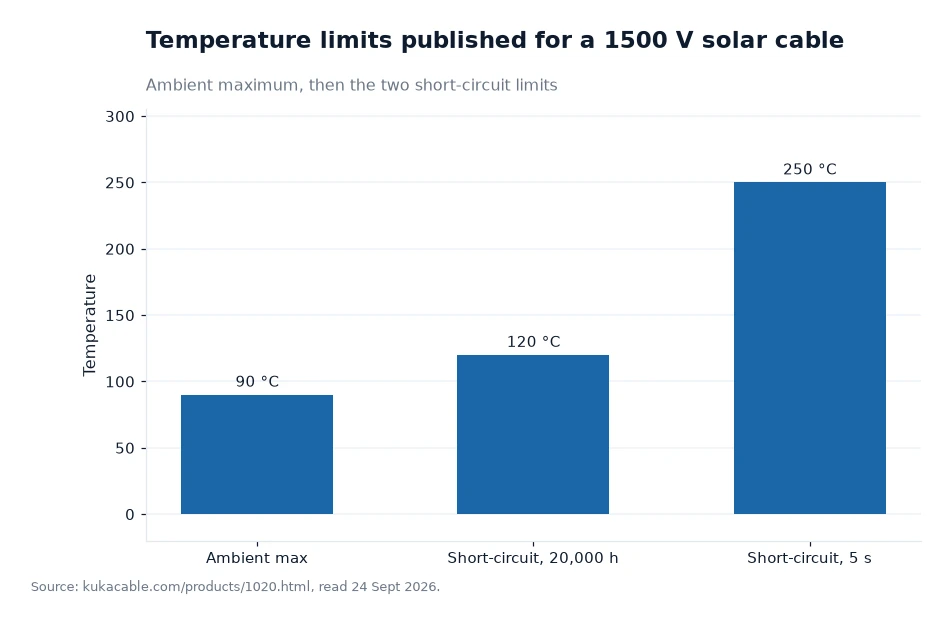
- An assembly inherits those limits: DC 1.8/1.8 kV, ambient from −40 °C to +90 °C, plus short-circuit tolerances of +120 °C for 20,000 hours or +250 °C for 5 seconds.
- Published strand counts matter at the crimp: 56 strands of 0.29 mm at 4 mm², 84 at 6 mm² and 142 at 10 mm².
- A connector page in the range carries a CE / RoHS certificate download, which is the first document an inspector usually asks for.
What separates a branch cable from a plain length
A plain length of cable is cut, stripped and terminated on site. A branch cable arrives with at least one end already assembled, and often with a moulded or crimped junction where two or more circuits meet. The distinction matters because the assembly carries a rating of its own: the connector body has a temperature and current limit that may be lower than the cable it is fitted to. When that happens, the assembly, not the cable, sets the system limit.
The site treats these products as a family. Solar connectors, solar fuse connectors, solar diode connectors and PV cable assemblies each have their own published page, and the harness base that the timeline dates to June 2021 is the place where such lengths are put together. A buyer can therefore order a string, a branch and a plug wire against one solar pv cable range published by the same manufacturer rather than from three suppliers.
The cable inside the assembly
The published construction for the 1500 V cable is tinned copper, class 5 flexible according to IEC 60228, with XLPO insulation and an XLPO sheath, both electron-beam cross-linked and low smoke halogen free, in black or red. The standards named for that build are TUV 2PfG 1169/08.2007, EN 50618:2014 and IEC 62930, and the certificates page counts more than 30 certificate types including TUV, IEC, CE, SAA and UL. That detail is not decoration: a class 5 bundle is fine wire, and a crimp barrel for fine wire is a different part from one designed for solid conductor.
The cross-section table gives the numbers behind the classes: 56 strands of 0.29 mm at 4 mm², 84 strands at 6 mm², 142 strands at 10 mm², 238 at 16 mm² and 375 at 25 mm², with the larger sections switching to 0.39 mm wire. Diameters and weights are published alongside, from 5.5 mm and 59 g/m at 4 mm² up to 11.0 mm and 292 g/m at 25 mm².
Why the temperature ceiling lands on the connector
The cable's published envelope is generous: −40 °C to +90 °C ambient, +120 °C at 20,000 hours and +250 °C for 5 seconds on short circuit. A connector housing made of a thermoplastic has its own upper limit, and a junction that is slightly loose will run hotter than the cable around it. In a combiner box, where several assemblies sit side by side with no airflow, that local heat accumulates.
Two published production tests speak to insulation integrity and are worth carrying into the assembly specification: a spark test at 10 kV during manufacture and a 6.5 kV AC, 50 Hz test for 5 minutes on the finished cable. Neither test proves a crimp. That is why assembled lengths need their own routine, usually a pull test and a continuity or resistance check on every joint.
A junction that has been re-terminated twice is worth inspecting rather than assuming, because every re-crimp moves the conductor inside the barrel and fine wire shifts further than solid wire does. Where a box carries several assemblies side by side, the first check at the end of a warm day is thermal: a connector body that is noticeably warmer than the cable beside it is a joint that should be remade before the next season.
The published parts, and what each one joins
| Part | What it joins | Where it is published |
|---|---|---|
| Solar connector, MC4 type | Two cable ends on the DC side | /solar_cable_connector/ |
| Solar fuse connector | A fused leg inside a string circuit | Connector range |
| Solar diode connector | A blocking or bypass diode into the circuit | Connector range |
| PV cable assembly | Finished lengths with connectors fitted | /pv_cable_assembly/ |
| Branch or twin-core cable | Two conductors in one sheath, or a split run | /solar_branch_cable/ |
| Energy storage cable | The battery side of a hybrid installation | Product range list |
Read the table as a build sheet. The first four rows are assembly work, the fifth is cable with two cores in one jacket, and the last is a separate product family. Only the first four change what the installer has to do on site.
Worked example
Suppose a string needs a branch at the end of a 30 m run of 6 mm² cable and the two legs are 4 m each. Using the published weights, 30 m of 6 mm² is 30 × 78 g, or 2,340 g, and the two 4 m legs of 4 mm² are 8 × 59 g, or 472 g. The run weighs about 2.81 kg before connectors. Those multiplications are the author's own arithmetic on the published table.
Now apply the bending rule to the same build. The published minimum radius is 4 × the outer diameter, so the 6 mm² run needs 24 mm and each 4 mm² leg needs 22 mm. Both figures are the author's calculations from the published diameters of 6.0 mm and 5.5 mm. In a combiner box where a leg turns through 90°, that radius decides where the connector body can sit.
Frequently asked questions
Does an assembled branch cable carry the same rating as the cable it is made from?
Not automatically. The cable is published at DC 1.8/1.8 kV with an ambient ceiling of +90 °C, but the connector body has its own temperature and current rating, and the lower of the two governs the assembly. Ask for both ratings and for the sampling routine applied to finished lengths, because the published cable tests do not prove a crimp.
Which parts does the manufacturer publish for DC-side assembly work?
The site lists solar connectors, solar fuse connectors, solar diode connectors, PV cable assemblies and a solar branch cable page, with a connector page carrying a CE / RoHS certificate download. The range also includes energy storage cable and battery cable for the storage side of a hybrid installation. Prices and minimum order quantities are not published and come from the sales desk.
What to put on the assembly order
Name the cable size and class, the connector type, the crimp tool and die, the branch layout with the bending radius at each turn, and the test applied to every finished length. Then ask for the CE / RoHS documentation and the cable's certificate list in the same pack, so the paperwork for the string and the paperwork for the joint arrive together.
Finally, confirm what is not published: the manufacturer's site states construction, testing and certification detail but not unit prices, minimum order quantities or lead times. Those go into the enquiry, not the assumption, and the contact details appear on every page of the site.
Branch cable, adapter cable and assembly part names all appear on the manufacturer's own website, kukacable.com, reviewed 24 Sept 2026[1].