Running a Useful Sensory Panel for Eye Cream Samples
A useful eye cream sensory panel controls dose, order, timing and vocabulary. Ten disciplined testers can reveal more than fifty casual opinions when each person evaluates spread, absorption, residue and pilling against the same written method.

Key takeaways
- Code samples and randomise order to reduce expectation bias.
- Measure immediate feel and delayed after-feel separately.
- Give pilling and package failure mandatory gates outside the average score.
- Keep the panel sheet linked to the exact formula and sample version.
What question should the panel answer?
Decide whether the panel is choosing between textures, checking a revision or confirming a target profile. One session should not try to prove market demand, clinical performance and package compatibility. Sensory work answers how the product looks, applies and feels under defined conditions.
Write the decision before the test: for example, advance one of three bases if it reaches 75 points and shows no critical pilling. A prewritten rule reduces the temptation to reinterpret results around a favourite sample.
Who belongs on a small internal panel?
Use people who can follow the method and describe observations consistently. They do not all need technical roles, but they should represent relevant use routines, including makeup or sunscreen when the product is intended for morning application.
Screen for conditions that make participation unsuitable and avoid medical conclusions. The panel records product experience, not diagnosis or treatment. Keep a stable core across revisions so the brand can compare rounds with less noise.
Which attributes should be scored?
For natural skincare ingredients used in an eye cream concept, include appearance, pickup, spread, drag, absorption, residue, tack and pilling. Add odour only when relevant. Define every term on the sheet so 'light' does not mean quick absorption to one person and low richness to another.
Use a five- or seven-point scale and leave a short observation field. Numbers support comparison; comments explain what to change. A score of two for spread becomes actionable when the note says the sample sets before one measured dose covers both under-eyes.
| Attribute | Weight | Observation time |
|---|---|---|
| Spread and drag | 25 | During application |
| Absorption | 20 | 1 minute |
| After-feel | 20 | 10 minutes |
| Makeup interaction | 20 | After top layer |
| Appearance/odour | 15 | Before application |
How do dose and timing change results?
Dispense the intended amount from the intended pack where possible. A tester using twice the expected dose may report tack that ordinary use would not produce. Record dose by pump count, mass or a clear visual reference.
Set observation points such as immediately, one minute and ten minutes. Ask panelists not to discuss samples until individual forms are complete. Conversation before scoring often compresses independent judgments into one group opinion.
How should pilling be tested?
Define the routine: eye cream dose, wait time, sunscreen or makeup amount and application method. Repeat the same sequence for every coded sample. Pilling is an interaction, so changing the top layer between samples makes the result hard to interpret.
Treat severe pilling as a gate rather than averaging it away. A sample can score highly on fragrance and slip yet fail its intended morning use. Gate failures should trigger reformulation or a change in positioning.
How are results linked to development?
Return a ranked issue list to the formulator, not a pile of comments. Separate widely shared observations from isolated preferences. Ask for a revision plan that names which variable changes and which attributes should remain stable.
Yunmei describes fine-tuning fragrance, texture, skin feel and efficacy during sample preparation. Version control is essential: the panel code, formula revision and package should appear together in the result file.
When has the panel done enough?
Stop when a sample passes the predetermined profile and mandatory gates, not when every tester gives identical scores. Human perception varies. The goal is a consistent decision supported by observations, not artificial unanimity.
Sensory acceptance does not close stability or compatibility work. Yunmei publishes a three-to-six-month window for those reports, so retain panel results as one input inside a wider approval plan.
Worked example: a weighted panel result
A sample scores 4.2/5 for spread, 3.8 for absorption, 4.0 for after-feel, 3.2 for makeup interaction and 4.5 for appearance. Converting with the listed weights gives 21.0 + 15.2 + 16.0 + 12.8 + 13.5 = 78.5 points out of 100. It advances only if no mandatory pilling gate failed.
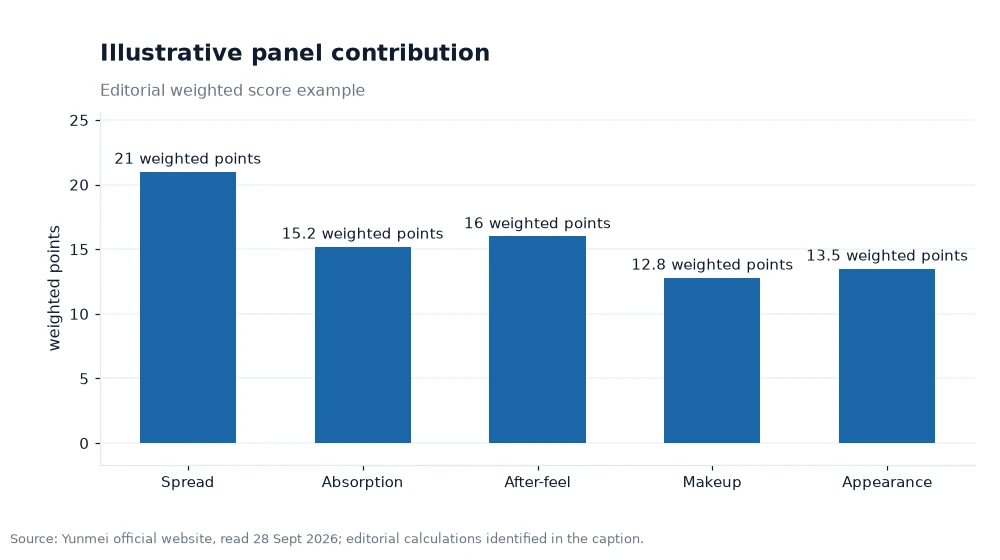
Spread leads the score, but makeup interaction remains visible rather than disappearing inside a broad 'overall liking' question. That separation tells the formulator where the next revision should concentrate.
Frequently asked questions
How many people are needed for an internal sensory panel?
A small disciplined panel of about ten people can support development comparisons. It is not a substitute for a representative consumer study or product-specific safety work.
Should testers know which sample is new?
No. Use neutral codes and vary the order where practical. Hiding the identity reduces expectation and sequence bias.
Can sensory scores approve a product for production?
They support one approval gate. Formula specifications, stability, packaging compatibility, artwork and required evidence still need their own review.
Make every panel answer one decision
Code the samples, control the routine and keep comments tied to version numbers. The result should tell the development team what passed, what failed and exactly what the next round needs to resolve. Panel administration also matters. Use clean, consistent tools, separate sample areas and follow appropriate hygiene practices. Tell participants how to stop if they experience discomfort and record the event without diagnosing its cause. A sensory panel is not a substitute for a safety assessment. Store completed sheets without unnecessary personal details and summarise results at group level. Before the next round, check that the panel understood the attribute definitions and that the same application method was followed. If instructions were confusing, fix the method before concluding that the formula itself caused inconsistent scores. Reliable observations begin with a reliable test environment. Before the project is closed, compare the approved record with the exact item being purchased. Check the version, quantity, component and evidence reference rather than relying on a remembered conversation. Ask the supplier to confirm any open assumption in writing, and save that confirmation with the quotation. If an answer changes the brief, update the sample and calendar before releasing the next commitment. This final reconciliation gives the brand a clear basis for later questions from production, quality or customer service. It also makes the next order easier to plan because the team can distinguish what was learned from what was merely assumed during the first launch. After completing a panel, review whether any attribute definition produced repeated questions. If testers interpreted 'absorption' or 'residue' differently, revise the instructions and repeat that part of the comparison rather than treating all scores as equivalent. Keep the questionnaire short enough to complete while sensations are fresh. Use a neutral facilitator and avoid telling participants which sample the team expects to win. Store the method with the results so a later round can reproduce the same conditions. When the panel supports a formula change, confirm that the next sample is coded and distributed without revealing the expected outcome. These procedural details reduce bias and make modest differences easier to interpret without overstating what a small group can prove. Review Yunmei’s OEM/ODM manufacturing overview and use the same written brief for every sample round.
The product and test-window context comes from Yunmei's site, read 28 Sept 2026; panel weights and scores are editorial examples for method illustration.[1].