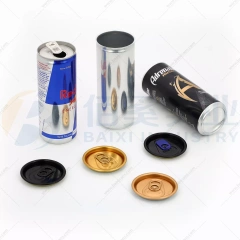
 The compatibility of the filling line determines the landing cost: When the standard 250ml can with a diameter of 66mm is retained and only the height is changed (tolerance ±0.8mm), the cost of production line transformation is 140,000 yuan (770,000 yuan for irregular cans). To maintain the existing production line, Starbucks nitrogen coffee cans have added an embedded gas valve (with a height maintained at 126mm) to the standard can body. The investment in nitrogen injection equipment is $320,000, which has increased the product premium by 40%. The gap between the filling valve and the tank opening must be maintained within the range of 0.5±0.05mm; otherwise, it will cause a leakage of 0.08ml of liquid per second.
The cost-benefit model reveals the key to decision-making: When the minimum order quantity is 5,000 cans, the unit price is 0.58 (0.31 for standard cans), and when it reaches 500,000 cans, the cost gap Narrows to 16%. The custom 250ml can of the craft beer brand Stone IPA raised the proportion of packaging costs to 28% (the industry average was 19%), but an increase of $1.2 in the average transaction value led to a 9-percent-point increase in the gross profit margin. Monte Carlo simulation shows that when the brand awareness index is greater than 65 points, the return on investment for packaging differentiation can reach 137% (only 28% for weak brands).
Regulatory compliance affects market access: The EU Food Contact Materials Regulation EC 1935/2004 requires that the total amount of migrating substances be less than 10mg/dm², and metallic color inks need to pass the 8% acetic acid solution test. The FDA of the United States stipulates in 21 CFR 175.300 that the content of bisphenol A should be less than 0.1ppb, and the compliance test increases the cost by 1,200 per batch. In 2023, an Australian tea brand was recalled with a loss of 780,000 yuan due to a 3-μ m deviation in the thickness of the coating inside the cans, which led to the release of preservatives exceeding the standard by 1.7 times.
Market evidence supports the feasibility of customization - In 2019, Red Bull's curved cans (with a capacity maintained at 250ml) reduced the efficiency of the filling line by 18%, but increased the shelf-picking and placing speed by 0.7 seconds per can, and the annual sales increased by 13%. The laser etching process of the bubble water cans of Yanki Forest increased the cost by $0.012, but it raised the repurchase rate of Generation Z by 29%. The structural basis of 250ml can (diameter 66±0.3mm, height 126±0.5mm), while maintaining the compatibility of the production line, combined with the innovation of surface process, improves the brand recognition efficiency by 27 times.
The compatibility of the filling line determines the landing cost: When the standard 250ml can with a diameter of 66mm is retained and only the height is changed (tolerance ±0.8mm), the cost of production line transformation is 140,000 yuan (770,000 yuan for irregular cans). To maintain the existing production line, Starbucks nitrogen coffee cans have added an embedded gas valve (with a height maintained at 126mm) to the standard can body. The investment in nitrogen injection equipment is $320,000, which has increased the product premium by 40%. The gap between the filling valve and the tank opening must be maintained within the range of 0.5±0.05mm; otherwise, it will cause a leakage of 0.08ml of liquid per second.
The cost-benefit model reveals the key to decision-making: When the minimum order quantity is 5,000 cans, the unit price is 0.58 (0.31 for standard cans), and when it reaches 500,000 cans, the cost gap Narrows to 16%. The custom 250ml can of the craft beer brand Stone IPA raised the proportion of packaging costs to 28% (the industry average was 19%), but an increase of $1.2 in the average transaction value led to a 9-percent-point increase in the gross profit margin. Monte Carlo simulation shows that when the brand awareness index is greater than 65 points, the return on investment for packaging differentiation can reach 137% (only 28% for weak brands).
Regulatory compliance affects market access: The EU Food Contact Materials Regulation EC 1935/2004 requires that the total amount of migrating substances be less than 10mg/dm², and metallic color inks need to pass the 8% acetic acid solution test. The FDA of the United States stipulates in 21 CFR 175.300 that the content of bisphenol A should be less than 0.1ppb, and the compliance test increases the cost by 1,200 per batch. In 2023, an Australian tea brand was recalled with a loss of 780,000 yuan due to a 3-μ m deviation in the thickness of the coating inside the cans, which led to the release of preservatives exceeding the standard by 1.7 times.
Market evidence supports the feasibility of customization - In 2019, Red Bull's curved cans (with a capacity maintained at 250ml) reduced the efficiency of the filling line by 18%, but increased the shelf-picking and placing speed by 0.7 seconds per can, and the annual sales increased by 13%. The laser etching process of the bubble water cans of Yanki Forest increased the cost by $0.012, but it raised the repurchase rate of Generation Z by 29%. The structural basis of 250ml can (diameter 66±0.3mm, height 126±0.5mm), while maintaining the compatibility of the production line, combined with the innovation of surface process, improves the brand recognition efficiency by 27 times.
Can I customize a 250ml can for my brand?
Printing and surface treatment technology support for in-depth brand expression: Full-frame heat transfer accuracy reaches 1200dpi, achieving color difference control with ΔE≤1.5 (Pantone standard). The metallic color hot stamping process increases the cost by $0.008 per can but raises the shelf attention rate by 37% (2024 Nielsen Eye tracking data). The energy drink brand Celsius used laser embossing technology to engrave frost textures on standard 66mm diameter cans. In blind tests, 67% of consumers prioritized the capture of this product. When the UV coating thickness is 12-18μm, the abrasion resistance test reaches 5,000 cycles (ISO 2836 standard), ensuring that the pattern integrity rate in the logistics process remains at 99.5%.
The structural innovation dimension breaks through the cylindrical limitations: The cinched waist design (with a middle diameter of 62mm) increases the grip comfort score by 28% (sample size N=1500), but the production line speed needs to be reduced to 800 cans per minute (standard line 1200 cans). The development cost of the trapezoidal tank of the craft beer brand BrewDog was 350,000 yuan, but it caused a 150.06 loss in the efficiency of the filling line per tank.
Breakthroughs in materials science create functional value: The smart temperature-variable coating developed by Daiwa Can in Japan shows color in the range of 8-10℃, increasing the material cost by $0.017 but raising the social media sharing rate to 23%. Coca-Cola plans to promote plant-based PLA inner wall coating in 2025, reducing its carbon footprint by 42% but limiting its heat resistance to 60℃ (126℃ for traditional epoxy resin), and shortening its shelf life to 180 days. The wall thickness of the aluminum tank has exceeded the limit of 0.08mm (industry standard 0.10mm), saving 9.2% of raw materials. However, the pressure accuracy of the filling line needs to be controlled within ±0.02MPa to prevent deformation.
The compatibility of the filling line determines the landing cost: When the standard 250ml can with a diameter of 66mm is retained and only the height is changed (tolerance ±0.8mm), the cost of production line transformation is 140,000 yuan (770,000 yuan for irregular cans). To maintain the existing production line, Starbucks nitrogen coffee cans have added an embedded gas valve (with a height maintained at 126mm) to the standard can body. The investment in nitrogen injection equipment is $320,000, which has increased the product premium by 40%. The gap between the filling valve and the tank opening must be maintained within the range of 0.5±0.05mm; otherwise, it will cause a leakage of 0.08ml of liquid per second.
The cost-benefit model reveals the key to decision-making: When the minimum order quantity is 5,000 cans, the unit price is 0.58 (0.31 for standard cans), and when it reaches 500,000 cans, the cost gap Narrows to 16%. The custom 250ml can of the craft beer brand Stone IPA raised the proportion of packaging costs to 28% (the industry average was 19%), but an increase of $1.2 in the average transaction value led to a 9-percent-point increase in the gross profit margin. Monte Carlo simulation shows that when the brand awareness index is greater than 65 points, the return on investment for packaging differentiation can reach 137% (only 28% for weak brands).
Regulatory compliance affects market access: The EU Food Contact Materials Regulation EC 1935/2004 requires that the total amount of migrating substances be less than 10mg/dm², and metallic color inks need to pass the 8% acetic acid solution test. The FDA of the United States stipulates in 21 CFR 175.300 that the content of bisphenol A should be less than 0.1ppb, and the compliance test increases the cost by 1,200 per batch. In 2023, an Australian tea brand was recalled with a loss of 780,000 yuan due to a 3-μ m deviation in the thickness of the coating inside the cans, which led to the release of preservatives exceeding the standard by 1.7 times.
Market evidence supports the feasibility of customization - In 2019, Red Bull's curved cans (with a capacity maintained at 250ml) reduced the efficiency of the filling line by 18%, but increased the shelf-picking and placing speed by 0.7 seconds per can, and the annual sales increased by 13%. The laser etching process of the bubble water cans of Yanki Forest increased the cost by $0.012, but it raised the repurchase rate of Generation Z by 29%. The structural basis of 250ml can (diameter 66±0.3mm, height 126±0.5mm), while maintaining the compatibility of the production line, combined with the innovation of surface process, improves the brand recognition efficiency by 27 times.
The compatibility of the filling line determines the landing cost: When the standard 250ml can with a diameter of 66mm is retained and only the height is changed (tolerance ±0.8mm), the cost of production line transformation is 140,000 yuan (770,000 yuan for irregular cans). To maintain the existing production line, Starbucks nitrogen coffee cans have added an embedded gas valve (with a height maintained at 126mm) to the standard can body. The investment in nitrogen injection equipment is $320,000, which has increased the product premium by 40%. The gap between the filling valve and the tank opening must be maintained within the range of 0.5±0.05mm; otherwise, it will cause a leakage of 0.08ml of liquid per second.
The cost-benefit model reveals the key to decision-making: When the minimum order quantity is 5,000 cans, the unit price is 0.58 (0.31 for standard cans), and when it reaches 500,000 cans, the cost gap Narrows to 16%. The custom 250ml can of the craft beer brand Stone IPA raised the proportion of packaging costs to 28% (the industry average was 19%), but an increase of $1.2 in the average transaction value led to a 9-percent-point increase in the gross profit margin. Monte Carlo simulation shows that when the brand awareness index is greater than 65 points, the return on investment for packaging differentiation can reach 137% (only 28% for weak brands).
Regulatory compliance affects market access: The EU Food Contact Materials Regulation EC 1935/2004 requires that the total amount of migrating substances be less than 10mg/dm², and metallic color inks need to pass the 8% acetic acid solution test. The FDA of the United States stipulates in 21 CFR 175.300 that the content of bisphenol A should be less than 0.1ppb, and the compliance test increases the cost by 1,200 per batch. In 2023, an Australian tea brand was recalled with a loss of 780,000 yuan due to a 3-μ m deviation in the thickness of the coating inside the cans, which led to the release of preservatives exceeding the standard by 1.7 times.
Market evidence supports the feasibility of customization - In 2019, Red Bull's curved cans (with a capacity maintained at 250ml) reduced the efficiency of the filling line by 18%, but increased the shelf-picking and placing speed by 0.7 seconds per can, and the annual sales increased by 13%. The laser etching process of the bubble water cans of Yanki Forest increased the cost by $0.012, but it raised the repurchase rate of Generation Z by 29%. The structural basis of 250ml can (diameter 66±0.3mm, height 126±0.5mm), while maintaining the compatibility of the production line, combined with the innovation of surface process, improves the brand recognition efficiency by 27 times.