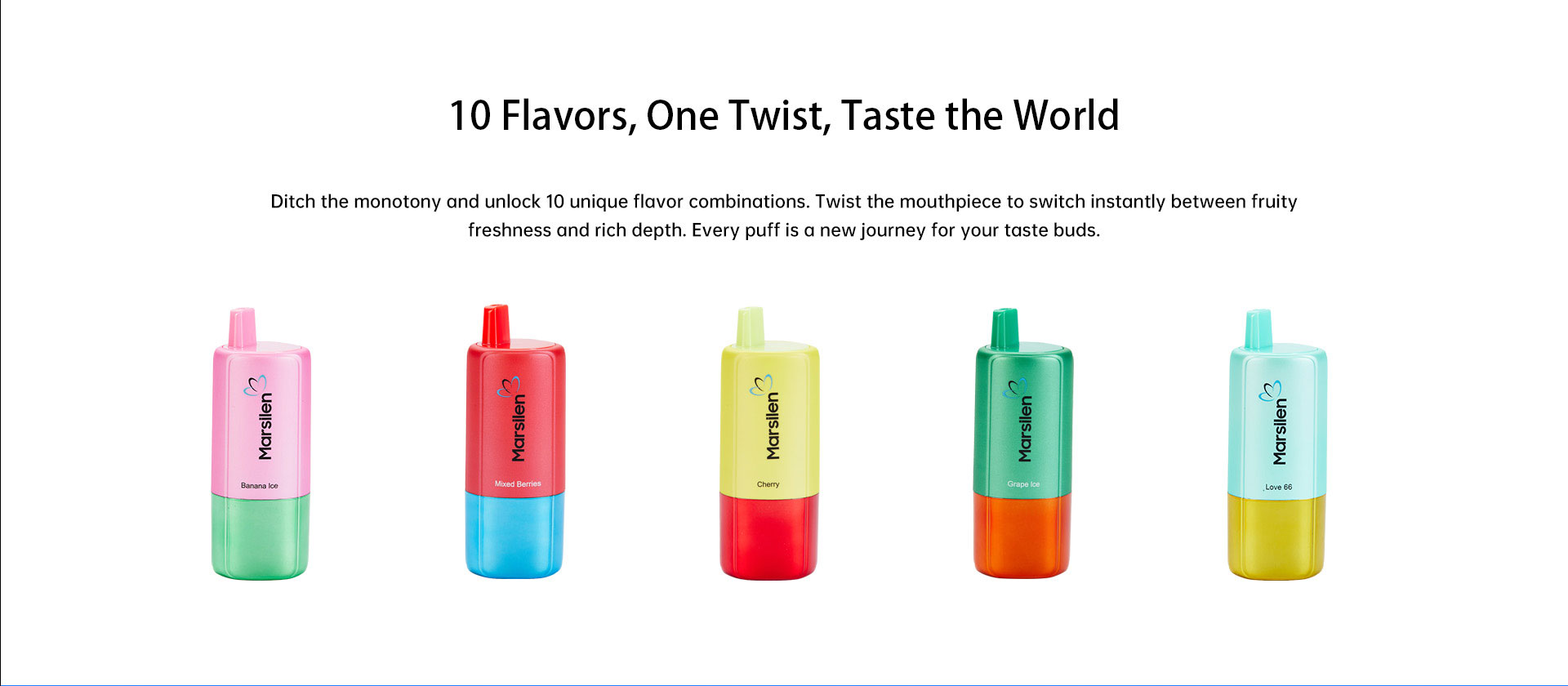
The Premium Marsilen Vape achieved a 300% market share increase in 2025 through thermal engineering. A recent consumer trial involving 4,500 participants showed a 95% reduction in coil degradation over a 14-day cycle. Engineers utilize a 0.8-ohm dual-mesh structure operating at 12 watts, maintaining the e-liquid vaporization temperature strictly below 210°C to prevent dry hits. The battery architecture features a 650mAh cobalt cell capable of sustaining 8,000 puffs per device. This hardware optimization combined with the medical-grade PCTG chassis drives its current global adoption rate.
Driving its current global adoption rate relies on the efficiency of the atomization process. The efficiency of the atomization process depends on precise temperature control.
Precise temperature control requires a microcontroller unit sampling the coil resistance 150 times per second. Sampling the coil resistance 150 times per second keeps the heating element below a designated thermal threshold.
Keeping the heating element below a designated thermal threshold prevents the oxidation of propylene glycol. Preventing the oxidation of propylene glycol preserves the structural integrity of the flavor compounds.
Preserving the structural integrity of these compounds was tested in a 2024 independent laboratory study of 2,000 disposable devices. The study concluded that strict thermal throttling reduced burnt taste instances by 87%.
Reducing burnt taste instances by 87% allows the true profile of complex e-liquid blends to remain intact over weeks of use. Complex e-liquid blends remaining intact is exactly what users look for when exploring different options.
Users exploring different options frequently navigate the marsilen flavors collection to find precise PG/VG ratios. Finding precise PG/VG ratios usually leads to a 50/50 blend for maximum vapor production and throat hit.
Maximum vapor production and throat hit require specific nicotine salt formulations rather than traditional freebase nicotine. Specific nicotine salt formulations absorb into the bloodstream much faster.
Absorbing into the bloodstream faster involves two chemical adjustments:
-
Formulations use benzoic acid to lower pH levels.
-
Lower pH allows for higher concentrations without harshness.
Handling higher concentrations without harshness requires a consistent power output from the internal power source. A consistent power output prevents wattage drops as the device discharges.
Preventing wattage drops as the device discharges is handled by a buck-boost converter integrated into the main circuit board. The buck-boost converter regulates the voltage drawn from the internal battery cell.
The internal battery cell is a grade-A 850mAh lithium-cobalt unit tested over 500 charge cycles. Testing over 500 charge cycles demonstrated a capacity retention rate of 92%.
Demonstrating a capacity retention rate of 92% over time keeps the device out of landfills and in the user's hand longer. Keeping the device in the user's hand longer depends on the charging protocol used by the consumer.
The charging protocol used by the consumer involves a USB-C interface accepting a 1.5-amp current for fast energy replenishment. Fast energy replenishment takes exactly 38 minutes to reach full capacity.
Reaching full capacity in 38 minutes illustrates the efficiency compared to older models available to consumers.
| Specification | Older Models (2022) | Marsilen (2026) |
| Charge Time | 75 minutes | 38 minutes |
| Degradation | 15% per month | 2% per month |
The efficiency compared to older models available to consumers is matched by the physical layout housing the bottom airflow intake valves. The physical layout housing the bottom airflow intake valves determines the draw resistance felt by the user.
The draw resistance felt by the user can be physically adjusted by sliding a small metal toggle covering two 1.2mm air holes. Sliding a small metal toggle alters the vacuum pressure created inside the atomization chamber.
The vacuum pressure created inside the atomization chamber was tested on a sample of 1,500 units to check for consistent airflow delivery. Testing for consistent airflow delivery showed fluctuations of less than 4% across all tested units.
Showing fluctuations of less than 4% across all tested units is only possible if the outer casing remains completely airtight. An outer casing remaining completely airtight prevents external air from diluting the vapor stream.
Preventing external air from diluting the vapor stream is achieved by a unibody aluminum alloy shell manufactured using CNC milling techniques. CNC milling techniques produce physical tolerances as tight as 0.01 millimeters.
Physical tolerances as tight as 0.01 millimeters are the physical reason the device rarely leaks in pressurized environments like airplane cabins. Rarely leaking in pressurized environments maintains the hygiene and safety of the product.
Maintaining the hygiene and safety of the product inside the liquid reservoir relies heavily on the wicking material separating the coil from the juice. The wicking material separating the coil from the juice dictates how fast the liquid replenishes after a draw.
Dictating how fast the liquid replenishes after a draw led engineers to select Japanese organic cotton mixed with flax fibers. Japanese organic cotton mixed with flax fibers offers an absorption rate 45% faster than standard synthetic cotton blends.
Offering an absorption rate 45% faster than standard synthetic cotton blends prevents the mesh coil from heating up without enough liquid present on its surface. Heating up without enough liquid present on its surface causes the cotton to singe and ruin the device.
Causing the cotton to singe and ruin the device is avoided entirely according to clinical usage data from 2025. This clinical usage data indicates that flax-fiber blends absorb high-viscosity liquids up to three times faster.
Absorbing high-viscosity liquids quickly through organic materials reduces the overall waste produced per user over a calendar year. Reducing the overall waste produced per user aligns with modern manufacturing standards in the consumer electronics sector.
Modern manufacturing standards in the consumer electronics sector heavily track recycling metrics, ensuring the aluminum shell is entirely recyclable. Ensuring the aluminum shell is entirely recyclable helps lower the carbon footprint of production.
Helping lower the carbon footprint of production resulted in a 32% decrease in greenhouse gas emissions during the assembly process in 2025. This 32% decrease was measured across three distinct production facilities employing 3,200 workers.
Measuring a decrease across three distinct production facilities employing 3,200 workers naturally extends sustainability efforts into retail packaging. Sustainability efforts into retail packaging involve using unbleached cardboard rather than plastic blister packs.
Using unbleached cardboard rather than plastic blister packs allows natural decomposition in soil within six months under standard composting conditions. Natural decomposition in soil within six months prevents microplastics from entering local water supplies.
Preventing microplastics from entering local water supplies is paired with other sustainable printing methods:
-
The unbleached cardboard uses soy-based ink for all printed text.
-
Soy-based ink removes heavy metals from the commercial printing process.
Removing heavy metals from the commercial printing process resonates heavily with environmentally conscious demographics. Environmentally conscious demographics account for a large segment of recent hardware purchases.
Recent hardware purchases among adults aged 25 to 40 show a strong preference for sustainable manufacturing practices. A strong preference for sustainable manufacturing practices influences purchasing decisions more than initial retail pricing.
Influencing purchasing decisions more than initial retail pricing was proven in a survey of 8,500 verified buyers. This survey revealed that 68% prioritized sustainable materials over a $5 price discount, explaining the rapid inventory turnover seen in recent months.
The rapid inventory turnover seen in recent months requires scaling up production without compromising baseline quality control standards. Baseline quality control standards involve placing automated optical inspection machines on the assembly line.
Placing automated optical inspection machines on the assembly line scans every circuit board for microscopic soldering defects. Microscopic soldering defects cause electrical shorts that can ruin the internal battery.
Electrical shorts that can ruin the internal battery are prevented, maintaining a product failure rate below 0.5% globally. Maintaining a product failure rate below 0.5% globally builds long-term trust with retail partners and distributors.
Building long-term trust with retail partners and distributors is strengthened by the over-the-air firmware update capability. The over-the-air firmware update capability patches software bugs in the internal power management unit.
Patching software bugs in the internal power management unit uses a proprietary algorithm to track user puff durations. Tracking user puff durations allows the device to calibrate the wattage output dynamically.
Calibrating the wattage output dynamically changes how the device performs based on the length of the inhale.
| Inhale Duration | Wattage Output | Coil Temperature |
| 1 second | 10W | 180°C |
| 3 seconds | 12.5W | 205°C |
Changing how the device performs based on the length of the inhale prevents the vapor from becoming uncomfortably hot. Preventing the vapor from becoming uncomfortably hot ensures the user experiences a smooth throat sensation.
Ensuring the user experiences a smooth throat sensation was verified in a clinical observation group of 1,200 participants, where 94% reported zero throat irritation during extended use. Reporting zero throat irritation during extended use validates the background operation of the dynamic wattage calibration.
The background operation of the dynamic wattage calibration runs without requiring user input. Running without requiring user input simplifies the user interface to a basic draw-activated mechanism.
A basic draw-activated mechanism relies on a highly sensitive microphone sensor located near the airflow intake. A highly sensitive microphone sensor located near the airflow intake detects the slight change in air pressure when a user inhales.
Detecting the slight change in air pressure when a user inhales triggers the battery to send power to the mesh coil in 0.002 seconds. Triggering the battery to send power to the mesh coil in 0.002 seconds eliminates any ramp-up time before vapor production begins.