Eighteen Hours to Test a Used Batch: 1 PH/s Before You Pay
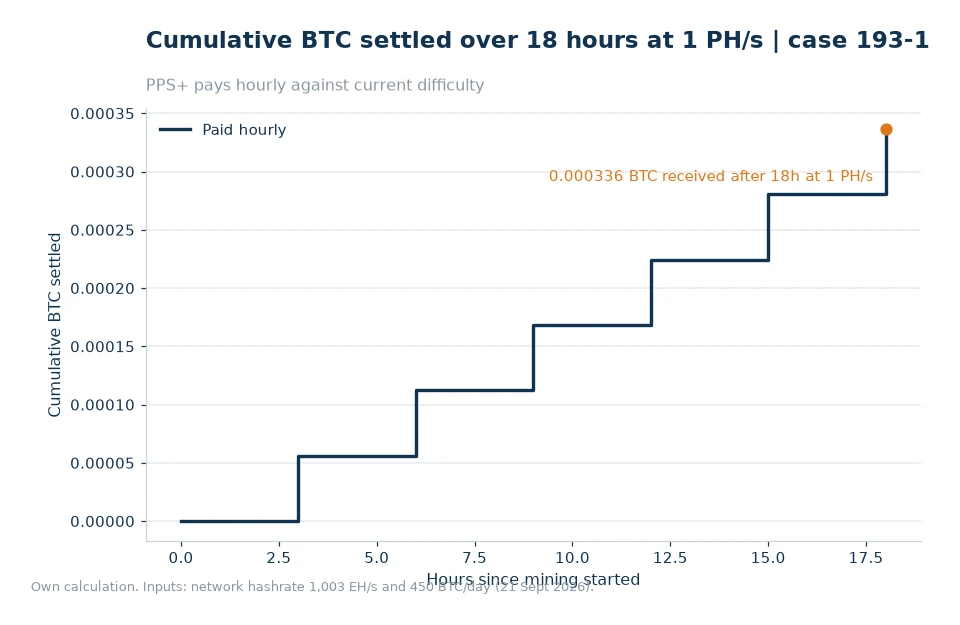
A seller's screenshot proves that a machine booted once. Eighteen hours under your own account proves what it does across a full evening and a working morning. At 1 PH/s the window should credit 0.00033645 BTC, or $28.49 at $84,692 per BTC, and a batch that misses that mark by more than a few percent is telling you something before the money moves.
Key takeaways
- Eighteen hours at 1 PH/s should credit 0.00033645 BTC, which is $28.49 at the read-date price.
- Point the machines at your own account, never the seller's, before judging anything.
- A 10% shortfall against the claim costs 0.00003365 BTC in this window, enough to renegotiate.
- Test across a temperature swing; a machine that only holds its rate in a cool room is a summer problem.
Why eighteen hours fits a viewing
Used hardware is usually sold in a hurry. The seller has a pallet, a buyer has a day, and both want the deal closed before the other changes their mind. Eighteen hours is the longest test that still fits inside that rhythm: arrive in the afternoon, run overnight, read the result over breakfast. It is also long enough for the room to warm up and for at least one difficulty day to pass.
The window is deliberately shorter than a full day. A batch that runs cleanly for 24 hours has proven slightly more, but the extra six hours rarely change the decision and often cost another night of hotel and storage. Eighteen hours catches the faults that matter for a used purchase: a board that drops under load, a fan that stalls when the room heats, a power supply that shuts down at the first sustained draw.
What the seller's dashboard leaves out
A local dashboard reports what the machine thinks it is doing. A pool account reports what the network accepted. The gap between the two is where used-hardware problems live: stale shares, an incorrect difficulty setting, a firmware build that reports a hashrate it cannot sustain. None of these appear on the screen in the seller's photograph.
Repointing the machines is therefore the first action, not the last. Create a worker name for the test, point every unit at it, and let the pool be the judge. If the seller resists a repoint, that is itself information. There is no technical reason a working machine cannot spend a night on a buyer's account.
Check Pool Hashrate against the claim
Pool Hashrate is the number to hold beside the seller's claim, because it is measured where the shares land rather than where the fans spin. If the batch is advertised as 1 PH/s and the pool sees 0.94 PH/s across the window, the shortfall is real and priced in credits. At 1 PH/s, 6% of eighteen hours is 0.00002019 BTC, about $1.71, and that is the smallest version of the problem.
The pool figure also removes an excuse. Ambient heat, a weak circuit, a shared network link: all of them show up as a lower pool-side rate, and all of them are the buyer's problem from the moment the pallet leaves. Measuring on the pool side converts a conversation about conditions into a conversation about a number both parties can see.
The ViaBTC Mining Statistics page puts the pool figure beside the network figure, which matters for a used purchase because the machines will be judged against a moving denominator. A batch that looks strong today may look ordinary in three months if the network grows, and the test cannot tell you that. It can only tell you whether the hardware delivers the hashrate it was sold as.
The step you cannot fake
Over eighteen hours the credit curve is a staircase of eighteen steps, each worth 0.00001869 BTC at 1 PH/s. A machine that has been quietly overclocked to pass a short test will often show a tall first few steps and then sag as thermal throttling takes over. The shape of the staircase is harder to fake than a single hashrate reading, which is why the test runs overnight rather than for an hour.
Look for the sag rather than the average. An average hides a batch that ran at 110% for two hours and 90% for sixteen. The step heights show it directly, and the point where they shrink tells you how long the hardware can sustain its rated speed in the room it will actually live in.
A checklist instead of a single number
Four checks cover most of what an eighteen-hour test can reveal. Each has a pass condition, so the decision does not depend on how the buyer feels at breakfast.
| Check | Where to read it | Expected at 1 PH/s | Pass condition |
|---|---|---|---|
| Worker uptime | Pool worker list | All units reporting | No dropout longer than one settlement |
| Sustained rate | Pool hashrate graph | 1.00 PH/s | Stays inside a 3% band after hour six |
| Credited output | Credit history | 0.00033645 BTC | Within 5% of the expected total |
| Thermal behaviour | Unit logs and room temperature | No throttle events | Rate holds through the warmest hour |
The order matters. Uptime first, because a unit that drops off makes every later number meaningless. Sustained rate second, because that is the claim being purchased. Credits third, as the dollar translation. Thermal behaviour last, because it explains any failure found in the first three.
Worked example: eighteen hours on the bench
Take a batch of ten units advertised at 100 TH/s each and run the arithmetic the buyer should have on a phone.
- Ten units at 100 TH/s each make the 1,000 TH/s being tested.
- Each terahash yields 450 ÷ 1,003,000,000 = 0.00000044865 BTC daily.
- The batch therefore produces 0.00044861 BTC a day.
- Per hour that is 0.00001869 BTC.
- Eighteen hours: 18 × 0.00001869 = 0.00033645 BTC.
- At $84,692 the window is worth $28.49.
- One unit's share is a tenth, 0.000033645 BTC or $2.85.
- A batch that reaches only 0.9 PH/s credits 0.00030281 BTC and leaves $2.85 on the table.
That last line is the negotiating position. A batch that is 10% short is not a rounding error; it is one machine in ten that is not there, and the price should reflect it.
Frequently asked questions
Is eighteen hours long enough to accept a used batch?
It is long enough to catch thermal throttling, dropouts and a hashrate that does not match the claim, since 1 PH/s should credit 0.00033645 BTC in that window; it is not long enough to assess wear.
Can the seller refuse to let me repoint the machines?
A refusal is a warning sign rather than a technical obstacle, because any working unit can spend eighteen hours on a buyer's worker name and the pool will record exactly what it delivered.
What shortfall should end the negotiation?
Treat more than 5% as material: at 1 PH/s a 10% gap is 0.00003365 BTC in the window, roughly $2.85 a day, and it persists for the life of the hardware.
Pay on the second morning, not the first evening
The test is only worth running if the payment schedule respects it. Structure the deal so the balance moves after the eighteen-hour result is read, and write the expected credit into the agreement as a number rather than a promise. A batch that hits 0.00033645 BTC at 1 PH/s has earned its price; one that does not has told you what to offer instead. The Miner Profitability Ranking helps price the model once the hashrate is confirmed, and the mobile app lets you watch the test overnight without sitting in the room.
Acceptance figures are arithmetic on data read 21 Sept 2026: 1,003 EH/s network, 132.76 T difficulty, 144 blocks a day of 3.125 BTC, BTC $84,692. Listed rates are on the ViaBTC pricing page[1]. The eighteen-hour run is assumed uninterrupted. Published 24 Oct 2026.